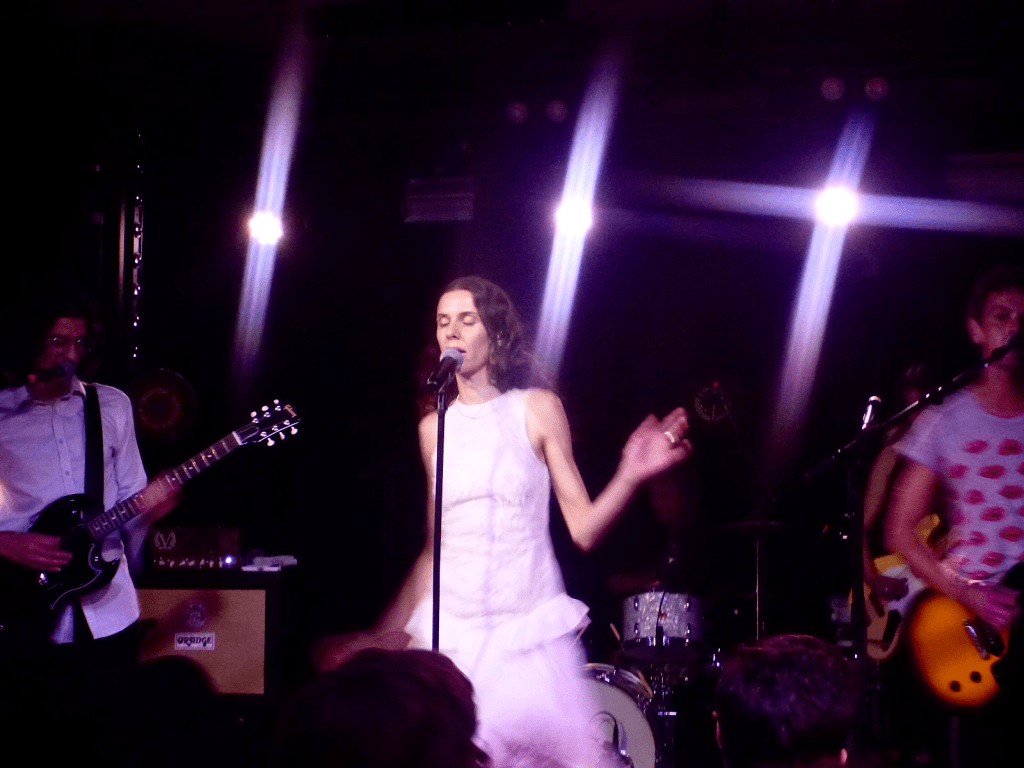
Jezmi (Tarik) Fehmi, Nina Cristante and Sam Fenton Of Bar Italia. Photograph: Leila Edelsztein Satz, 19-06-25 at 93 Feet East, Bricklane, London.
In Mark Fisher’s Ghosts of my Life (2014), he describes the London syphoned through Burial’s music as ‘a wounded city, populated by ecstasy casualties on day release from psychiatric units, disappointed lovers on night buses, parents who can’t quite bring themselves to sell their Rave 12 inches at a carboot sale, all of them with haunted looks on their faces, but also haunting their interpassively nihilist kids with the thought that things weren’t always like this’ (99).
These carefully curated semantics of a muted, post-90s libidinally derelict London evince the visceral way in which a band can insert their listener into a specific lifeworld. With lyrics like:
“See the unimportant styles
Some essay made when they get tired
Of living on the outside like you do
Who would’ve thought that you would last this long
You know
There’s no surprises that you feel like this
And I don’t doubt that you can’t take in
Anymore” (Bar Italia. “Polly Armour”);
the London featured in Bar Italia’s music can be felt as a city out of sync with itself.
Whether it’s Sam Fenton, Jezmi Fehmi or Nina Crisante singing (or all of them), their voices are incessantly desynchronized both sonically and lyrically, cracking and sighing across slightly distorted, textured guitar and occasionally punctuated by the crashing of Nina’s tambourine. Much like the hauntingly acidic polyvocals in Tricky and Martina Topley-Bird’s ‘Maxinquaye’, the merging and iterating of Bar Italia’s voices in and out of each other makes it unclear to the listener whether they are hearing a dialogue, or a singular splintered consciousness expressing itself through more than one vessel and gender. This results in an anxious vocal interactivity that feels more restless and fractured than it does fluid, a sonically synesthetic world of missed connections, lifeworlds out of sync with each other, where intuitive connection is just beyond reach.
In the music video for the song “My Little Tony”, a low-definition, hand-held camera follows footsteps from London’s colourless, raining streets into an overstuffed flat party, sporadically freezing on someone’s pallid, checked-out expression or hazy grin. Bar Italia’s world – steeped in a resigned despondency that quickly pivots into an adrenalised, slacker-rock drawl – is aptly visualised in this video. It is an overcrowded room where the two people who most want each other spend the night in conversation elsewhere, looking over shoulders at each other with glazed eyes and glancing away before their gaze can be met.
The desynchronisation that permeates Bar Italia’s songs does not appear to stem from a place of unrequited romantical love, but rather from an inability to assimilate the people around them and the terrain they find themselves inhabiting; resorting to unsettled observations such as “fear has a fetish for eyes” in order to compose a reality that might finally feel tangible. The social polyrhythmic that Bar Italia taps into is, ironically, the very arrhythmia that an overpopulated, over-monetized city such as London imposes on its inhabitants. It is a paradox that anyone who has lived in a capital city at any given point has felt at least once; the relatability inherent to not being able to relate to anyone. Theirs is a cityscape in which the disconnected seek solace in each other’s company whilst the rest of its population sleeps (heeding the plea “Creep into my bed | Some dark nights get into my head | Some dark nights get into my head | Can you turn me up?” (Bar Italia. “Punkt”).
Pitchfork’s reviews on Bar Italia range from commending their arrhythmic eeriness as ‘music so unsettling, and so serpentine, that it almost feels as if it’s laughing at us’, to somewhat cynical comparisons: ‘Fehmi has a distressing tendency to caterwaul like Robert Smith at his most despondent’, and finally, ‘at points, the trio’s gestures feel more suggestive of a hazy past than any potential future’ (2023). What is especially interesting about recognising the band’s haunting dissonance and simultaneously attributing it to a long-standing tradition of vocal despondency is the implication that despondency has become perpetual. In this sense, it is inaccurate to claim that Bar Italia are simply reproducing the sound of a bygone era. Rather, their desynchronised and dissonant despondency is very much of the present. In contrary to Pitchfork’s musings, I would argue that the despondency Bar Italia invokes is not borrowed second-hand from those who came before them, successfully transplanted yet no longer contextualised, but is simply the persistence of that despondency within youth culture. Not only are we still lamenting a certain disconnectedness, a desynchronisation of rhythms, but we are now experiencing the active choosing of this disconnectedness. Perhaps the true haunting of Bar Italia, then, is its intimation that the affective state we find ourselves in has become, against all odds, more familiar than its inverse.


 ribs recordings
Leave a comment