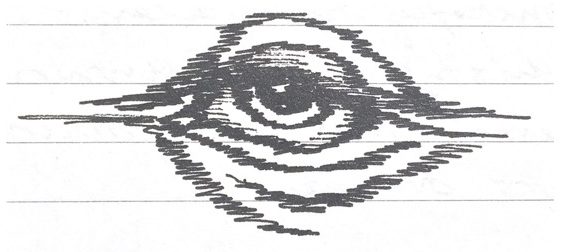
Voyeurism, evolved from the French voyeur – meaning the one who sees – has over time become used to define the sordid pleasure derived from watching someone unaware they are being watched. But what of the inevitable fantasy of being the vu, the seen, in everything that you are and do? This is not to be confused with the plight of the exhibitionist, or the trending term ‘male gaze’. Instead, it is the imagined watchfulness of something much less tangible and much more intrinsic. I think, more than anything, that it has to do with the self and a dissociation from it.
It is impossible to talk about the paradigm of the watcher and the watched in the twenty-first century without talking about porn. I often find that within the conversation surrounding porn, there are pivotal after-effects being left out. Namely, you hear of the inculcating of men with sexually violent behaviours and a concerning indifference when confronted with the reality of physical intimacy. However, the after-effect that I find to be the most pervasive is that of the ‘POV’ (Point of View). It goes without saying that pretty much every perspective and camera angle has been exploited to the fullest, and so I say this with an acute awareness of its generalisation, but it is always the most watched videos that are filmed from the man’s perspective, from which you see nothing but his lower body as though you were effectively his eyes fixed into his own head. It would be inaccurate to conclude that this only makes men sexually self-absorbed and women believe that sex is an act of service. In reality, it makes both self-absorbed but in wholly different ways. The man acquires the kind of limited, self-entrenched skills of perception that come with seeing your own perspective affirmed and represented again and again; while the woman becomes her own voyeur – so completely absorbed in observing herself that it simultaneously becomes the least and most selfless act; she is in it for herself but she is not within herself. It’s this fatal separation of the self into two – the voyeur and the vu – that ultimately seeps into ones own understanding of selfhood.
However, this is not to say that the voyeur-vu exists in a permanent state of dissociation. In my own experience, I’ve existed under the watchfulness of some abstract extension of myself for so long that it seems completely ordinary, and mostly doesn’t make me feel any less present. I’ll suddenly become aware of a kind of dual containment – the feeling that I am the person contained and simultaneously the person containing, observing, approving or disapproving – and it is more than a filter, or a moral compass. While it may be at times influenced by the imagined eyes of someone I admire (or want to be admired by), it feels quite literally like some omniscient presence constantly there. These eyes can take different forms. In an enlightening conversation with a friend at seventeen, we were shocked to realise that in order to give ourselves any kind of physical gratification we both needed to imagine a person watching silently in the corner. We started referring to this as ‘the old man at the edge of the room’, but I suppose what we really meant was that we needed to feel somehow consumable to an objective gaze to be able to justify ourselves. This need for a voyeur shouldn’t be mistaken for exhibitionism. The desire of the exhibitionist is to achieve a sense of gratification from being on display. To reap this sense of gratification, a person must be able to feel located within the self that is being seen, requiring a certain corporeal wholeness that the voyeur-vu lacks. Because, circling back to my first disclaimer, this is not ‘the male gaze’ – some concise and gendered internalised view. It is just the self that contains, it is an extension and a severance, both self-absorbed and self-expelled.
This leads me to my second example of the voyeur-vu complex: self-location. I’ve found that I harbour a kind of desperation to be seen on a day to day basis, if anything to confirm that I am a real person existing amongst other real people. This completely eludes my flatmate, who grew up in the outskirts of Sheffield and often tells me that she craves an expansive and isolated field, a walk where she will encounter nobody. Nothing, I think, would prove more disconcerting to me. Contrary to how this may sound, I do actually love being alone, I just like to be alone and be seen, in the eye line of an affirming witness, whether it be myself detached or the unspoken acknowledgment of a stranger. Even tasks such as waking up are littered with imagined watchfulness – solemn distaste, ‘look at how late it is, how lazy she’s being’, or ‘wow! She’s making a smoothie, what a very put together girl’. There is a certain self-narration that takes place here, and while it might very well be that I am simply describing an internal monologue, it is undeniable that this is what it means to be your own voyeur. I feel like I’m better at being alone when I’m surrounded by people because I can inhabit myself more completely. It is in the act of observing that I become most grounded in myself, as though I were a viewpoint from which to view – a solid and certifiable place. I am turned into a location; whereas being alone in isolation allows for a kind of unpleasant borderlessness.
My favourite example of this dislocation/location in the self takes place through Milan Kundera’s use of mirrors and cameras in his iconic novel The Unbearable Lightness Of Being (1984). Narrated by an extradiegetic voice that alternates between four central characters, The Unbearable Lightness Of Being presents a structural refraction of perspectives. Kundera’s repeated use of mirrors and camera lenses echo this within the characters lives, as the device through which their relationships to themselves and each other are syphoned; the medium through which they are turned into locations for viewing, or, alternatively, confronted with a sense of dislocation – of borderlessness.
It is by standing in front of the mirror with Tomas, and later Franz, that Sabina and her counterpart briefly inhabit a dual vision of themselves and each other. In contrast, for Tereza the mirror elicits a certain disembodiment – dismembering her essence from its physicality precisely through reflecting her naked body. It is only from behind the camera lens that she is able to become the surveyor.
When she’s told in Geneva to take photographs of naked women and seeks out Sabina, the camera serves as ‘both a mechanical eye through which to observe Tomas’s mistress and a veil by which to conceal her face from her’ (Kundera. 62). The camera subsequently undergoes a certain metamorphosis. It ceases to be the vehicle of journalism that it was in Prague, and instead becomes to her as the mirror is to Sabina, with one vital difference: its ability to ‘veil’. She sees through the phantasmagoric eyes of Tomas, in his absence, the figure of the woman. However, unlike the mirror, she is not watching herself watching. The camera lens filters Sabina’s nudity to her while at once concealing her gaze from both herself and Sabina, abstracting her role as voyeur. Without it, she is ‘Literally disarmed: Deprived of the apparatus she had been using to cover her face and aim at Sabina like a weapon’ (62). One way of understanding this triangulation of the gaze is through John Berger’s Ways of Seeing (1972), referring back to the porn-induced self-severance of the woman:
‘Men look at women. Women watch themselves being looked at. This determines not only most relations between men and women but also the relation of women to themselves. The surveyor of woman in herself is male: the surveyed female. Thus she turns herself into an object – and most particularly an object of vision: a sight.’ (47).
The rendering of woman into an object of vision is what refracts her selfhood into two: the surveyor and the surveyed. In wielding a secondary gaze separate from her person, both Tereza and Sabina are able to visually ventriloquize the male surveyor in Tomas. The result is something like a mobius loop of gazes.
The mirror’s refraction of gaze – and in turn sense of self – has a very different effect on Tereza. She wonders ‘Had her body the right to call itself Tereza? And if not, then what did the name truly refer to? Merely something incorporeal, intangible?’ (134). This is the borderlessness to which I refer. In this moment, to be faced with the reflection of her own body presents an unsettling dissonance between her physical being and her mind. More accurately, Tereza seems to feel that her reflection both obscures and anonymises her essence. Where the camera undresses Tereza by abstracting her face from the act of witnessing, the mirror’s confrontation of her body incurs an alienation from the corporeal.
It’s through Tereza’s melancholy feeling of borderlessness that I feel I’m best able to explain the origins of my wish to be beheld in public spaces.
Living in and of itself entails a kind of narcissism, an inclination towards the autobiographical. As someone interested in creative writing, I often find myself frustrated at how difficult it is to write beyond my own personal experience. Every feeling or perception I can conjure is invariably a projection of my own at some point in time. Again, then, the inevitable self absorption of living, and writing about living, begs the question of what it is to be an exhibitionist. I found a particularly interesting distinction in Annie Erneux’s Simple Passions (1991):
‘Naturally I feel no shame in writing these things because of the time which separates the moment when they are written – when only I can see them – from the moment when they will be read by other people, a moment which I feel will never come. (…) It is a mistake therefore to compare someone writing about their own life to an exhibitionist, since the latter has only one desire: to show themselves and to be seen at the same time.’ (28).
I think this goes beyond just writing, because when you are not quite within yourself, this delay between showing and seeing festers in the space between you and the world.
Jacques Lacan’s ‘mirror stage’ theory aptly interprets this voyeur-vuism as a developmental step in the psyche. Explained as the gaining of apperception, the theory denotes the moment in which a child recognises themself from the third person viewpoint. What I find interesting here is the idea of the mirror as the most significant and primary means of self-reflection. This is a literal interpretation that, in a time of constantly developing technology and ever pervasive media, no longer holds. The mirror stage occurs everyday, multiple times, through an unquantifiable synthesis of self projections. Voyeurism in the traditional sense of the word is no longer characterised through the ‘Peeping Tom’ – an effort taken to physically conceal oneself and watch – all it requires is a stable network connection and a certain process of self-transference begins. This transference doesn’t need to entail a picture or a video. It can constitute any kind of minute, externalised self-expression.
This being said, how can anyone remain whole?
Works Cited
Berger, John. Ways Of Seeing. (London: Penguin Books, 1972)
Ernaux, Annie. Simple Passion. (Fitzcarraldo Editions, 2022)
Kundera, Milan. The Unbearable Lightness of Being. Translation by Micheal Henry Heim. (London: faber and faber, 1984)
Lacan, Jacques. Écrits. Translation by Alan Sheridan. (London: Routledge Classics. 2001) <http://faculty.las.illinois.edu/rrushing/581b/ewExternalFiles/Lacan%2C%20Mirror%20Stage.pdf> [Accessed 7/01/24]
 ribs recordings
Leave a comment