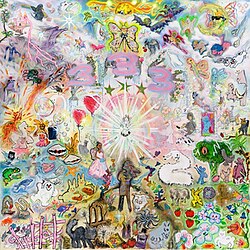
Bladee’s album art for 333, 2020
Around six months ago I went through a difficult breakup, faced potential houslessness and developed severe auto-immune responses to everything and anything. In this time, drain became the only music that I could tolerate. Drain had been lingering on the periphery of my listening habits since I was sixteen, but in a kind of self-effacing way, mostly because of the acute awareness that I did not belong in its usual listener demographic. Like the allegorisation of Christopher Nolan’s The Matrix by incel communities (and the broader manosphere), listeners of drain have garnered a reputation as a non-showering, alt-right, unemployed boys club – or draincels – in spite of Bladee’s disavowal. What appealed to me was maybe part of the same reason that he unwillingly gathered such a fanbase: in contrast to the majority of male fronted rap, the emotional palette of Bladee’s lyricism is distinct in its constant flux between cryptic poeticism, nihilistic musings and vaguely spiritual/theological allusions, rarely centering women or money. At times, his sound veers closer to genres like IDM or hauntology, but rebounds to a pervasive lightness (and almost vacuousness) affected by exaggerated auto-tune and glittery hyper-pop mixing that prohibits the darkness or gravitas shared with the latter. It’s this saccharine lightness that in the last half year became a seductive mode of aural sense-making.
Bladee is the founding member of the Swedish music collective Drain Gang. Emerging from the dredges of soundcloud rap in 2013, the group includes artists Ecco2k, Thaiboy Digital, Yung Sherman, and producer Whitearmor. Melting together elements from virtual realities, videogame soundtracks and electronic music, Drain Gang (DG) are perpetually in dialogue with each other – featuring prominently in the solo work of fellow members. According to de facto leader Bladee (Benjamin Thage Dag Reichwald), the philosophical framework of drain is one of “loss and gain”, of how you can drain something of its essence in a productive way but at the same time suffer from feeling drained of lifeforce:
Drain is about loss and gain; it could be good or bad — you could be drained of energy or you could drain something to gain energy. There’s financial, emotional and physical drains, […] if I’m talking about ‘eating the night’ that means I drain it for its essence. Everything me and my bros do is connected to that concept — we might drain some blood for good fortune. (Wordgirl).
In this way, Drain becomes the prefix to a kind of energetic, vampirical currency, with lyrics like:
Right now stepping on the graves even
Everything will wither and decay
But the energy will stay
Everyday, early, late, every second even
Turn away for nothing, just in case
A sensation but it’s strange
In a way everything is a secret even
Call myself a vessel, not a name
[…]
Endlessly reflecting in your gaze
Drop the mirror and it breaks
Seven years, seven tears, seven different heavens
Blue and black, I chase another shade
And I’m transcending the grey
(Bladee, “Noblest Strive”, 333, 2020),
Put a concept on that feeling
Take a word and change the meaning
(Bladee, “Reality Surf”, 333, 2020)
I am King Nothing, I am nothing
Take a bunch of empty words and make them mean something
(Bladee, “Hotel Breakfast”, The Fool, 2021)
The world affected through Bladee’s music is littered with recurring references to mirrors, ice, magic(/sorcery), swords/crests, blood, nightfall, darkness/sky, and intimations of a hollowing of self (“Call myself a vessel, not a name”), sung in a voice devoid of emotion or grain, ultra-processed through autotune. The lifeworld that emerges is one steeped in the fantastical and mythological, tinged with references to videogame-esque violence and satirised drug references – “Put a pill in a McFlurry, I’m goofy, Shoot me, acting for the cameras, it’s a movie” (Bladee, “I’m Goofy”, 2018) – that ultimately dissolves into a slurry of incongruent aesthetics, meaningful only through their meaninglessness. Even when the lyrics are more sombre, Bladee’s cadence remains a level, computerised stream: the world created by drain sounds almost painless, anaestheticising (or draining) its listener of emotional charge.
In a more recent interview about the album title “Trash Island”, Bladee divulged: “This material world and material things — it’s all trash. […] The world is a trash island. You have the power to create your own reality.” (Angell). The ethos of drain comes through then as built upon an admission of unbearable lightness (to borrow Milan Kundera’s iconic title and take it wildly out of its context): It’s the bends and kinks in the reality of a generation afflicted by internet psychosis, lifted into an increasingly digital gig economy, gorged on hyper individualism/consumersim, alter-egos and meme culture. There is something cathartic in making sense of this present through music that reproduces it playfully, leaning into its senselessness as opposed to diagnosing it. It’s like sonified plastic that knows it’s plastic – synthetic interplay between the embodied listener and the technological: the astral plane, auto-tuned “vessel” self, “King Nothing”.
Although not identifying with any organised religion, the albums “Crest” and “333” are couched in an iconography of heaven, angels, and spirit/more-than-human worlds beyond deity or dogma. Some Reddit threads speculate that this shift came after Bladee was literally struck by lightning in 2019, attributing the sense of yearning for something beyond the self in his lyrics to a post near-death experience pursuit of the kind of connection that can only be found within the convocation demanded of rave culture, or a transcendence of afterlife. In abstracting the self first into a pluralised set of autotuned voices in constant collaboration/dialogue with each other – electronically mediated to the point of depersonalisation (the voice without the body, the body without organs) – but also through the at once extremely vapid and mythological subject matter of his music, to listen to drain seems to me to live with an unbearable lightness of being as a mode (or maybe more accurately a coping mechanism) of aural sense-making. A lifetime of listening to music as a way of both deepening and affirming my emotional states ended with Bladee, and I obsessively embarked on a diet of strict aural meaninglessness that is only now beginning to taper.
Works cited:
Angell, Jack. “Being Bladee”, Fader, 2019
https://www.thefader.com/2019/09/17/bladee-interview-drain-gang-trash-island
[Accessed 10th Sept 2026]
Bladee. “Noblest Strive.” 333. YEAR0001. 2020. Track 9.
>https://open.spotify.com/track/4qA6oEXpK6NlmLG37PiABi?si=9e25eca4f8c04d17
—. “Reality Surf.” 333. YEAR0001. 2020. Track 8.
>https://open.spotify.com/track/6HJszgJO19tAKff7X40ggp?si=52c196aa92b14bd4
—. “Hotel Breakfast.” The Fool. YEAR0001. 2021. Track 3. >https://open.spotify.com/track/55CayibAnUWXdUwy2J68yB?si=0cb0a08025334df6
—. “I’m Goofy.” Red Light. YEAR0001. 2018. Track 14.
> https://open.spotify.com/track/2aSsrTaWOv2pvxmQmKyNll?si=fe8ec6a61aee4ce4


Leave a Reply